


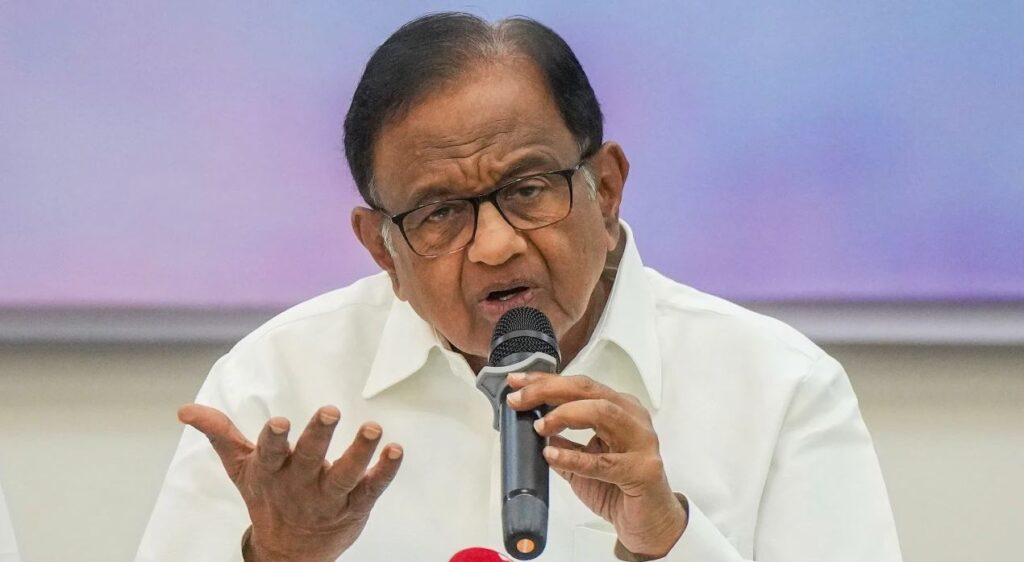
Senior Congress leader and former Union Minister P Chidambaram raised critical questions on Wednesday regarding the Indian government’s delay in restoring the statehood of Jammu and Kashmir. He termed the abrogation of Article 370 and the subsequent reorganisation of the region seven years ago as a “Constitutional outrage”.
On the seventh anniversary of this significant decision, which transformed Jammu and Kashmir into two Union Territories, Chidambaram emphasized that the repercussions of this action did not end there. He pointed out that a fundamental legal question about the validity of dividing a state into Union Territories remains unresolved.
In a post on the social media platform X, Chidambaram stated, “Seven years ago this day, a Constitutional outrage was perpetrated, splitting the State of Jammu and Kashmir into two Union Territories.” He further added that the Supreme Court had previously refrained from adjudicating this issue, as the government had assured the Court that statehood would be restored “soon”.
Chidambaram critically questioned, “How soon is ‘soon’?” His comments reflect broader concerns regarding the Indian government’s repeated promises on restoring statehood without any concrete timeline.
Highlighting the implications of the decision, Chidambaram expressed that the precedent set by the government in Jammu and Kashmir poses a lingering threat to the federal structure of other states within the country. He argued that the potential for the government to bifurcate any state into Union Territories remains a significant concern for India’s federal integrity.
Chidambaram’s assertions resonate with many observers who believe that the actions taken in Jammu and Kashmir could undermine the power of individual states in the union. He asserted, “That sword power of the Government to break up a State into UTs still hangs over the States of India.”
The discussion around Jammu and Kashmir’s statehood comes at a time when the region continues to deal with socio-political challenges. The uncertainty surrounding its political status and the absence of a clear timeline for restoration continues to spark debates among political parties, civil society, and the broader public.
As the government faces increasing pressure to address the statehood issue, Chidambaram’s remarks serve as a poignant reminder of the ongoing frustrations and aspirations of the people of Jammu and Kashmir. They highlight the crucial need for transparency and accountability in the political processes affecting the region.


